Is a Hip Replacement Considered a Disability?
A hip replacement can qualify as a disability under Social Security Administration (SSA) rules if it significantly limits your ability to function or work full-time.
Approval for disability benefits with a hip replacement depends on the severity of your condition, how long your limitations last, the medical documentation supporting your claim, and how your hip replacement affects your daily activities and ability to maintain employment.
Depending on your work history and financial situation, you may qualify for Social Security Disability Insurance (SSDI), Supplemental Security Income (SSI), or both. The SSA recognizes hip replacements as a musculoskeletal impairment and evaluates them under the Blue Book’s physical impairment listings.
Common Hip Replacement Symptoms the SSA Looks For
When evaluating disability claims related to hip replacements, the SSA looks for symptoms that affect physical functioning, particularly mobility and endurance. Common symptoms include chronic hip pain, stiffness, reduced range of motion, weakness, and difficulty bearing weight on the affected joint.
The SSA also considers whether symptoms worsen with activity, persist despite treatment, or fluctuate in severity. Ongoing pain, instability, and limitations following surgery, especially when recovery takes longer than expected—are important factors in determining eligibility.
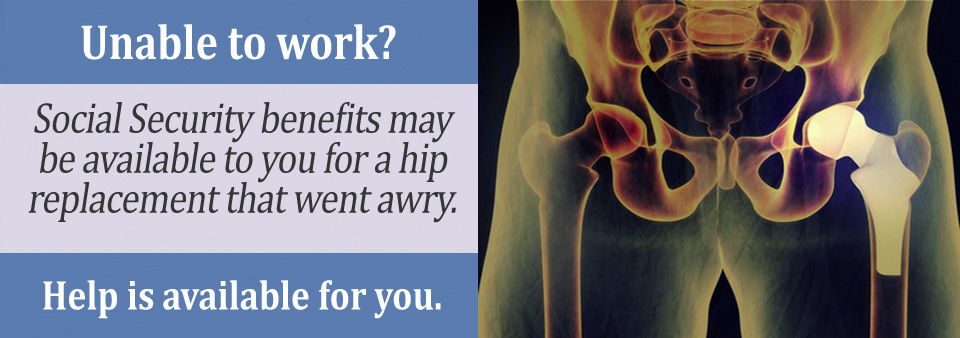
How a Hip Replacement Can Affect Your Ability to Work
A hip replacement can interfere with many basic work-related activities. Individuals may struggle with standing, walking, bending, lifting, or climbing stairs for extended periods of time. Chronic pain and reduced mobility can limit productivity and make it difficult to complete a full workday.
Recovery complications may also require frequent medical appointments, physical therapy, or rest periods, leading to inconsistent attendance. Even after surgery, some individuals continue to experience limitations that prevent them from returning to physically demanding or even moderately active jobs.
SSA Medical Criteria for Hip Replacements
The SSA requires medical evidence to evaluate hip replacement disability claims. Hip replacements are evaluated under Section 1.03 of the Blue Book, which covers reconstructive surgery of a major weight-bearing joint. To meet this listing, medical records must show that you:
- Are unable to ambulate effectively, and
- Are not expected to regain effective ambulation within 12 months of surgery
Supporting evidence may include:
- MRI, CT scans, or X-rays
- Physical exams and surgical records
- Physical therapy notes
- Use of assistive devices such as a cane or walker
- An “inability to ambulate” defined by the SSA
- Reports describing how your condition affects daily activities
In short, qualifying under the SSA’s hip replacement listing comes down to how well your medical evidence shows long-term walking limitations after surgery. The stronger and more consistent your records, the better your chances of approval.
If You Don’t Meet the SSA Criteria With a Hip Replacement
Many applicants qualify for disability even if they do not meet the exact requirements of Section 1.03. In these cases, the SSA evaluates your Residual Functional Capacity (RFC). You may qualify based on limitations such as:
- Difficulty standing or walking for long periods
- Needing to change positions frequently
- Limited ability to lift or carry weight
- Chronic pain affecting pace and productivity
- Need for ongoing medical care or rest breaks
Chronic complications, failed treatments, prolonged recovery, or degenerative joint issues can further strengthen an RFC-based claim.
Qualifying for SSI or SSDI With a Hip Replacement
SSDI eligibility is based on your work history and the number of work credits you have earned, while SSI is a needs-based program for individuals with limited income and resources.
A strong hip replacement disability claim is supported by consistent medical treatment, orthopedic evaluations, surgical and physical therapy records, diagnostic imaging, and documentation showing that symptoms persist despite treatment.
Work history demonstrating reduced capacity or inability to return to employment is also important. Initial denials are common, and many successful claims are approved during the appeals process.
How Much Does Disability Pay With a Hip Replacement?

Disability benefit amounts are not based on having a hip replacement itself, but on your work history and financial situation.
For SSDI, monthly payments typically range from about $1,200 to $2,000 per month, depending on your prior earnings. Some individuals with long and consistent work histories may receive up to $4,000+ per month.
For SSI, monthly payments are based on financial need and are capped at the federal maximum. In 2026, SSI payments are up to approximately $990 per month for individuals and about $1,490 per month for couples, with some states offering additional supplements.
In addition to monthly payments, some applicants may also qualify for back pay, which can total several thousand dollars or more, depending on when the SSA determines your disability began and how long your claim takes to process.
How a Disability Lawyer Can Help
A disability lawyer can help organize medical evidence, communicate with the SSA, obtain expert medical opinions, and guide you through the application or appeals process.
If your claim is denied, an attorney can represent you at hearings and manage all required filings. Disability lawyers do not charge upfront fees and are only paid if you win your case.
Get Help With Your Hip Replacement Disability Claim Today
If complications from a hip replacement are preventing you from working or living independently, you may be eligible for Social Security disability benefits.
Getting help early can improve your chances of approval and reduce delays. You can start by taking a free disability case evaluation to understand your eligibility and next steps.
